


Resources
Webinar: Navigating AI Costs, Risks, and Governance
Recorded on May 12, 2026
When institutional leaders discuss AI adoption, the conversation often starts with licensing fees. But the real story is broader: adopting AI at scale requires both visible financial investments and hidden resource commitments in time, people, and culture. Our research found that institutions must also navigate a rapidly expanding vendor market, with AI features rolling out faster than governance can address. This session provides a clear framework for understanding the full spectrum of costs, real and hidden, and the governance foundations that must be in place before scaling. This session is designed for CFOs, CIOs, budget officers, procurement leads, and compliance officers who control resources and risk.
Presenters:
Dr. Audrey Ellis, Founder & Principal, T3 Advisory
Norman Palmer, Director of Technology & Innovation, Complete College America
Webinar: Building AI Capacity-Training, Roles and Culture (Recording)
Recorded on April 21
Professional development for AI is both uneven and underdeveloped across higher education. Our research found that faculty often receive more structured training opportunities than staff, and many institutions lack a clear strategy for who delivers training, what content is prioritized, and how training connects to institutional goals. This session explores four emerging training roles—faculty/peer trainers, administrators, students, and external partners—and offers a framework for building sustainable AI capacity that reaches everyone, not just those who opt in. This session is designed for Senior leaders of Academic and Student Affairs, HR leaders, teaching and learning center directors, faculty development coordinators, and department chairs responsible for professional development.
Moderator: Dr. Audrey Ellis, Founder & Principal, T3 Advisory
Panelists:
Dr. Jennifer Gebelein, Director of AI Integration and Faculty Success, Florida International University
Dr. Greg Morris, Senior Vice Provost, Dallas College
Melissa Vito, Vice Provost for Academic Innovation, University of Texas San Antonio
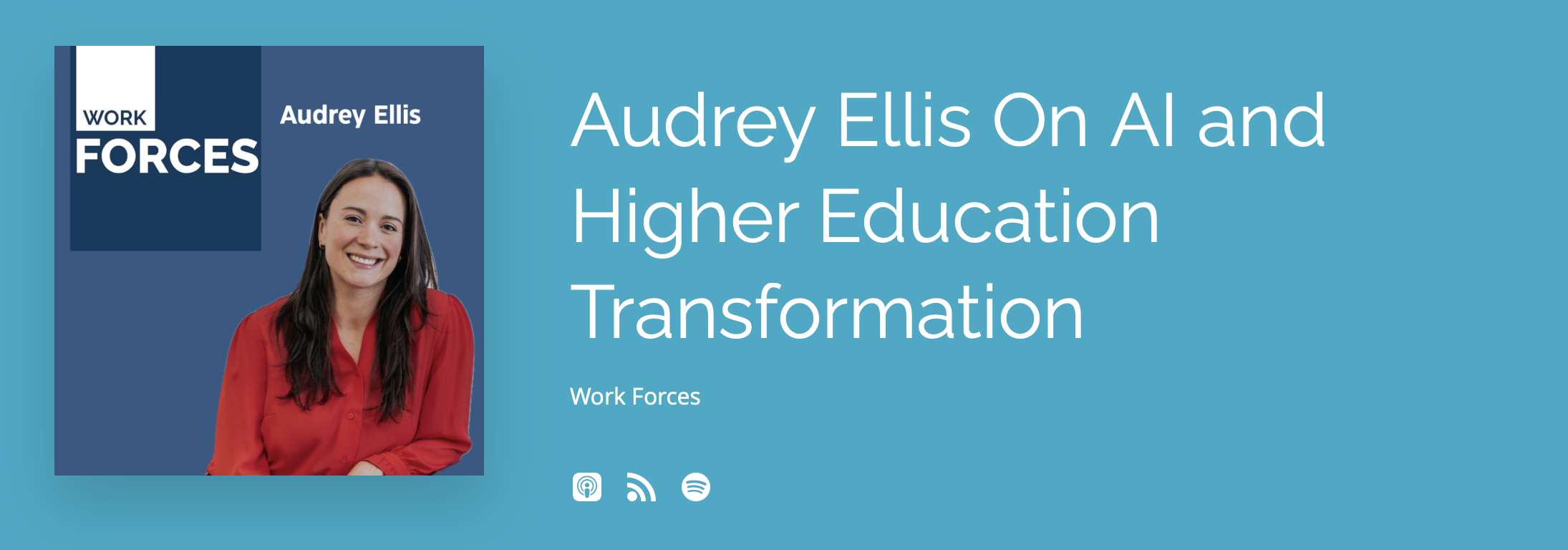
Workforces Podcast: Audrey Ellis On AI and Higher Education Transformation
Work Forces Podcast: Audrey Ellis on AI and Higher Education Transformation
T3 Advisory founder Audrey Ellis joins Julian Alssid and Kaitlin LeMoine on the Work Forces podcast to discuss findings from the AI for Institutional Transformation national study. The conversation covers why most institutions are taking a decentralized approach to AI adoption, how resource levels are shaping a widening gap between institutions, and where the biggest untapped opportunities exist in areas like advising and financial aid. Audrey makes the case for why institutional leaders need to take an active strategic stance on AI now, and shares free tools including T3's AI Adoption Rubric and AI Readiness Survey Suite as immediate next steps.
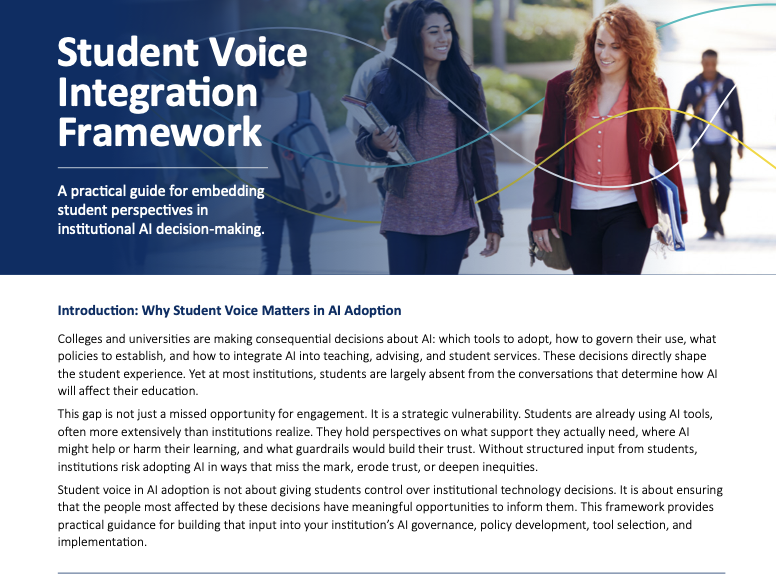
Tool: Student Voice Integration Framework
A practical guide for embedding student perspectives in institutional AI decision-making in higher education.
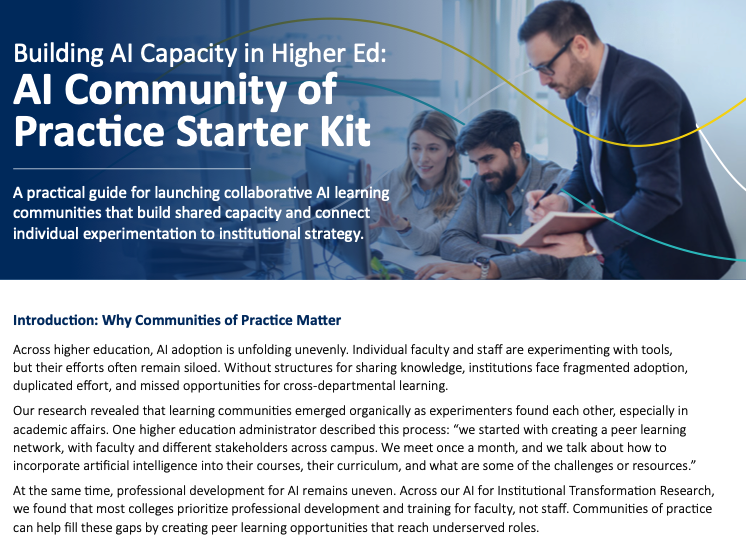
Tool: AI Communities of Practice Starter Kit
A practical guide for launching collaborative AI learning communities that build shared capacity and connect individual experimentation to institutional strategy.
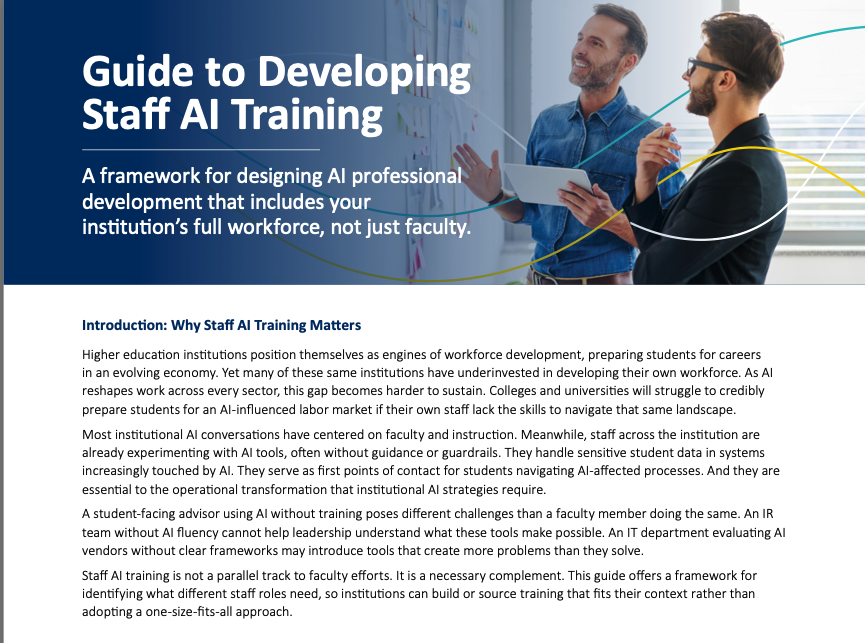
Tool: Guide to Developing Staff AI Training
Why staff AI training deserves its own strategy, and a framework to get started.
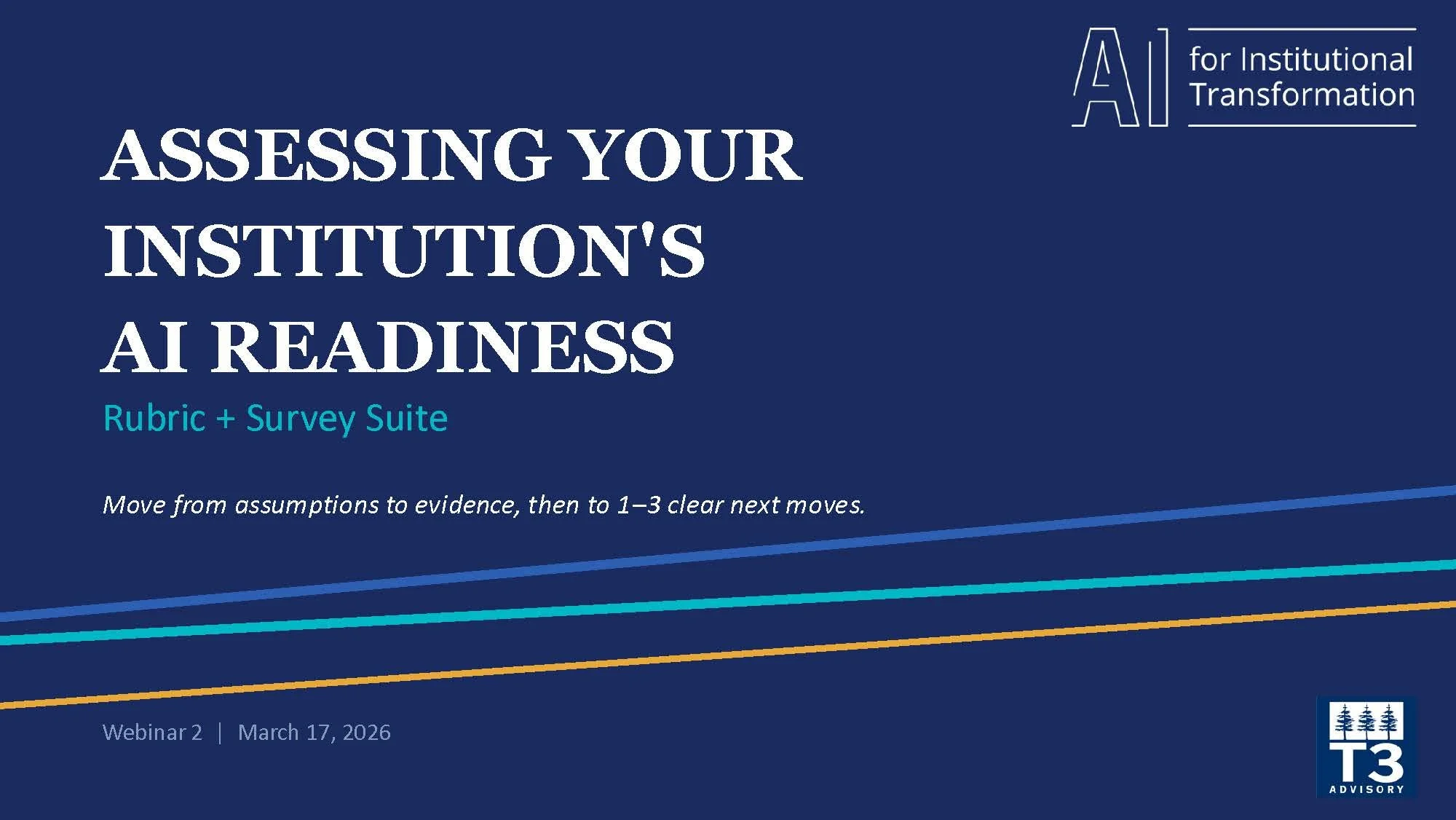
Webinar: Assessing Your Institutions AI Readiness (Recording)
Recorded on March 17, 2026
The research completed at T3 Advisory revealed a persistent gap: institutions know they need to engage with AI, but many lack a clear picture of where they actually stand. This session introduces T3's AI Adoption Rubric and Survey Suite: practical tools designed to help you move from assumptions to evidence. You'll learn how to assess across five dimensions (adoption coordination, leadership support, policy development, resource commitment, and technology deployment), deploy surveys to faculty, staff, students, and leadership, and translate findings into action.
What we cover:
Why most institutions remain in fragmented, uncoordinated AI experimentation
The five dimensions required for effective, institution-wide AI integration
How the “permission gap” limits adoption despite leadership support
Using the AI Adoption Rubric and Survey Suite to assess readiness and align stakeholders
Why AI policy should start narrow and evolve over time
Where to begin: defining a shared vision for AI’s long-term impact
Speakers:
Dr. Audrey Ellis, Founder & Principal, T3 Advisory
Mohammad Obiedat, Deputy CIO – ERP & AI, ACCS
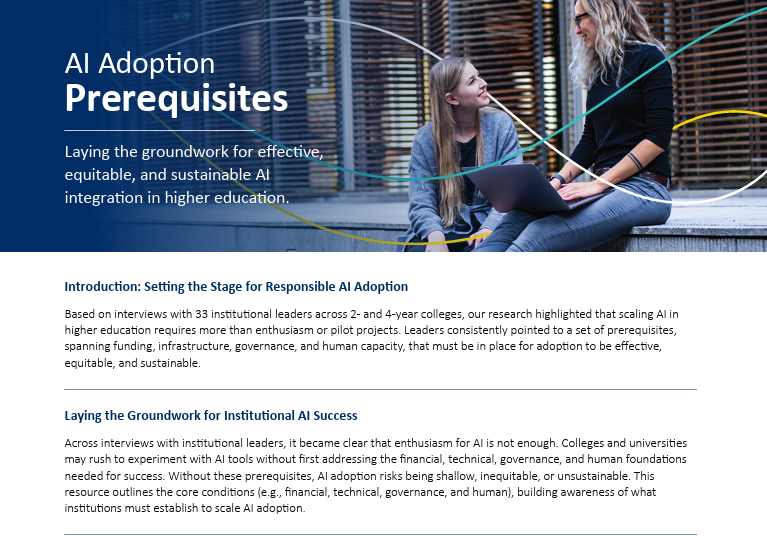
Brief: AI Adoption Prerequisites
Based on interviews with 33 institutional leaders across 2- and 4-year colleges, our research highlighted that scaling AI in higher education requires more than enthusiasm or pilot projects. Leaders consistently pointed to a set of prerequisites, spanning funding, infrastructure, governance, and human capacity, that must be in place for adoption to be effective, equitable, and sustainable.
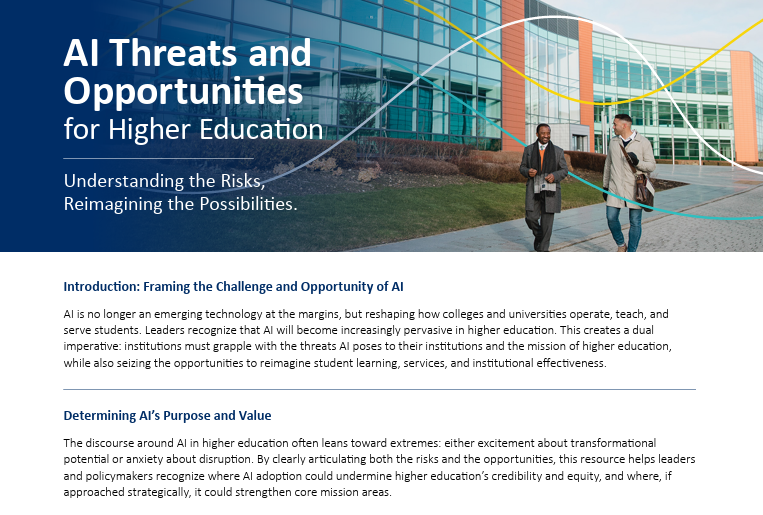
Brief: AI’s Threats and Opportunities
AI is no longer an emerging technology at the margins, but reshaping how colleges and universities operate, teach, and serve students. Leaders recognize that AI will become increasingly pervasive in higher education. This creates a dual imperative: institutions must grapple with the threats AI poses to their institutions and the mission of higher education, while also seizing the opportunities to reimagine student learning, services, and institutional effectiveness.
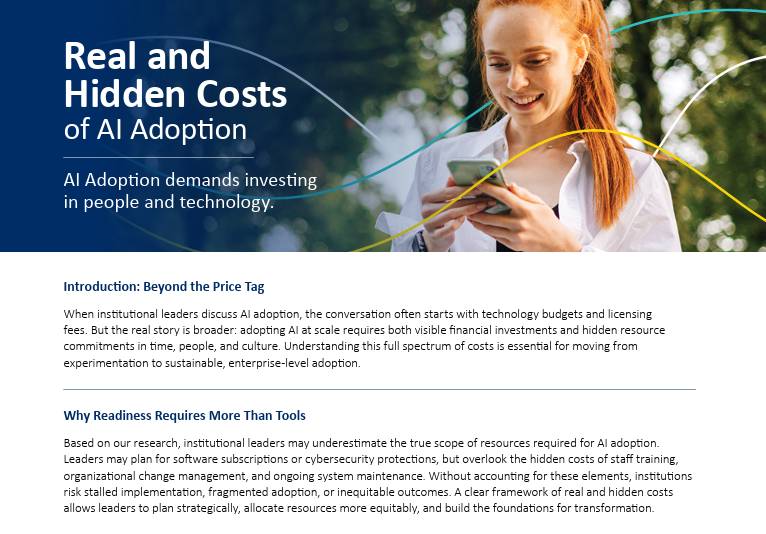
Brief: Real and Hidden Costs of AI Adoption
When institutional leaders discuss AI adoption, the conversation often starts with technology budgets and licensing fees. But the real story is broader: adopting AI at scale requires both visible financial investments and hidden resource commitments in time, people, and culture. Understanding this full spectrum of costs is essential for moving from experimentation to sustainable, enterprise-level adoption.
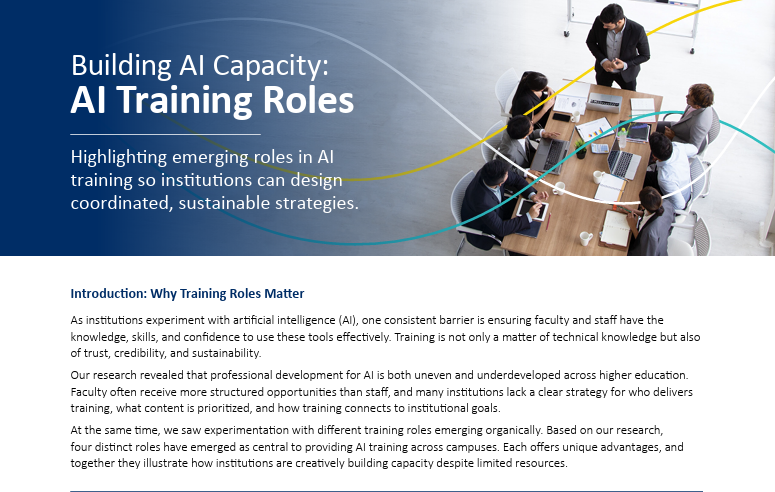
Tool: AI Training Roles
As institutions experiment with artificial intelligence (AI), one consistent barrier is ensuring faculty and staff have the knowledge, skills, and confidence to use these tools effectively. Training is not only a matter of technical knowledge but also of trust, credibility, and sustainability.
Tool: AI Prompt Battle Challenge Cards
These Prompt Battle Challenge Cards invite teams to design, test, and refine AI prompts across high-stakes institutional scenarios—from curriculum redesign and student success to faculty development, finance, and assessment. This in-depth deck helps leaders build hands-on AI fluency through collaborative problem-solving and real-world practice.
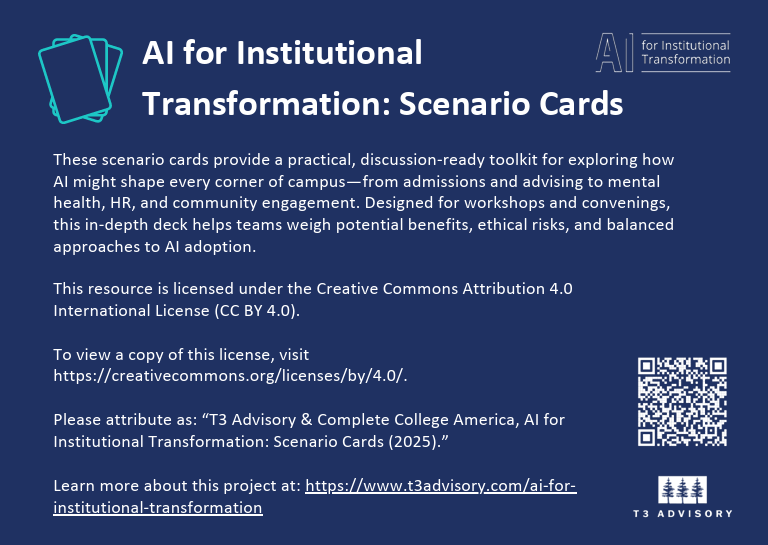
Tool: AI Scenario Card Game
This scenario deck is designed to support colleges and universities as they explore the opportunities, risks, and practical considerations of adopting AI across institutional functions.
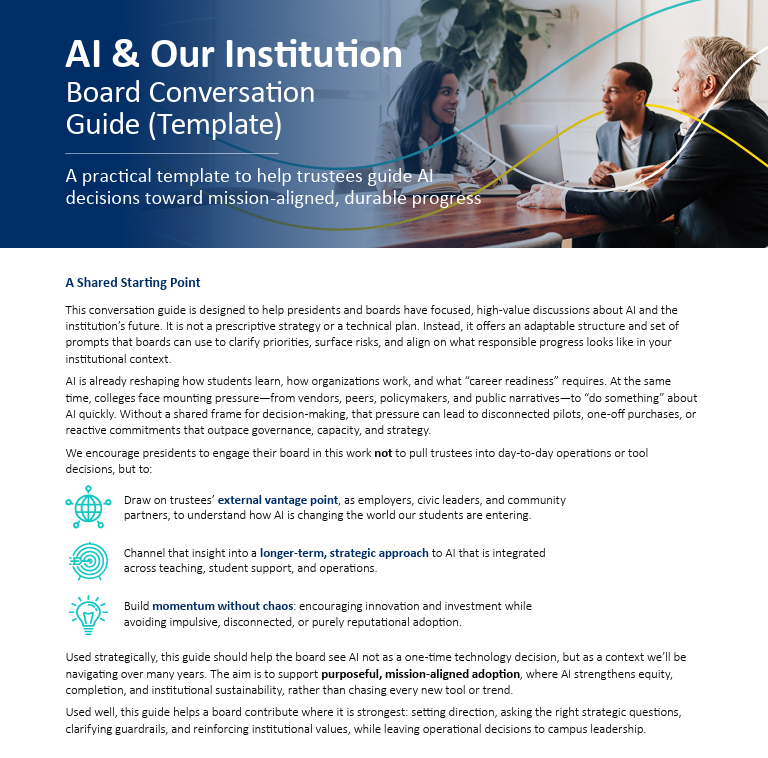
Tool: Board Conversation Guide
This conversation guide is designed to help presidents and boards have focused, high-value discussions about AI and the institution’s future. It is not a prescriptive strategy or a technical plan. Instead, it offers an adaptable structure and set of prompts that boards can use to clarify priorities, surface risks, and align on what responsible progress looks like in your institutional context.
AI is already reshaping how students learn, how organizations work, and what “career readiness” requires. At the same time, colleges face mounting pressure—from vendors, peers, policymakers, and public narratives—to “do something” about AI quickly. Without a shared frame for decision-making, that pressure can lead to disconnected pilots, one-off purchases, or reactive commitments that outpace governance, capacity, and strategy.

Tool: AI Prompting Guide
Artificial intelligence tools are becoming everyday companions in higher education, shaping how we learn, teach, and work. Yet, the quality of what these tools produce depends heavily on how we communicate with them. Crafting effective prompts (the instructions we give to an AI system) is a core skill for unlocking value while ensuring responsible use.
Based on our research with institutional leaders, many colleges and universities are still at early stages of AI adoption, where experimentation is driven by individuals rather than coordinated strategy. This hesitancy was partially due to a lack of knowledge and confidence. Faculty and staff often lack comprehensive training on how to effectively use AI tools, leading to shallow implementation in classrooms and student services or, in some cases, not engaging at all. This results in missed opportunities: those closest to student learning and institutional operations are also those best positioned to identify innovative solutions, yet without AI literacy they cannot fully leverage these tools.
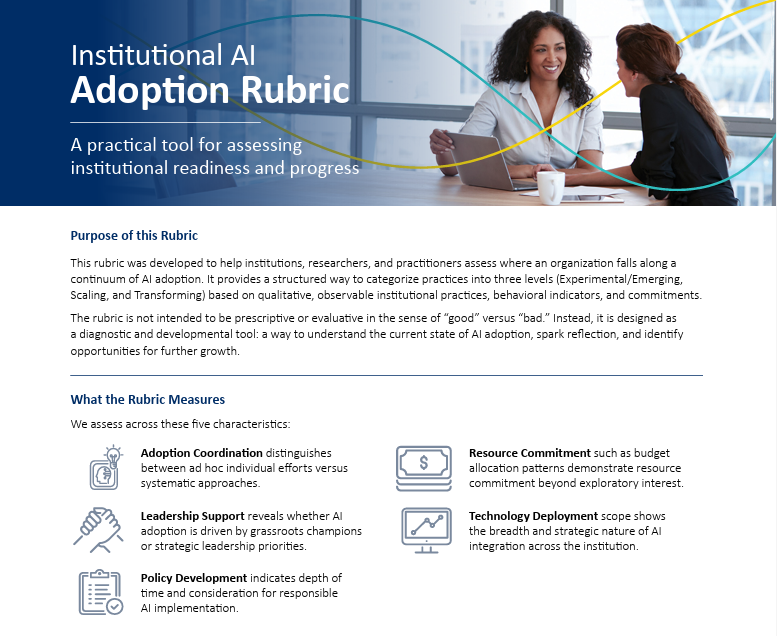
Tool: AI Adoption Rubric
This rubric was developed to help institutions, researchers, and practitioners assess where an organization falls along a continuum of AI adoption. It provides a structured way to categorize practices into three levels (Experimental/Emerging, Scaling, and Transforming) based on qualitative, observable institutional practices, behavioral indicators, and commitments.
Tool: AI Readiness Survey Pack (Includes Editable Templates)
This survey pack helps institutions assess AI readiness across multiple stakeholder groups. Rather than relying on assumptions or anecdotal evidence, these instruments provide structured data to inform AI strategy, resource allocation, and support planning. Structured instruments to assess AI readiness across leadership, departments, staff, and students.
Report: Adopting AI in Higher Education: Patterns, Challenges, and Emerging Practices
This in-depth report offers a comprehensive analysis of how colleges and universities across the country are adopting artificial intelligence—uncovering national patterns, institutional challenges, and emerging practices from interviews with leaders at 33 diverse institutions. It provides a detailed, data-rich foundation for understanding the uneven landscape of AI adoption and the opportunities ahead for higher education.
Report: Ten Lessons We Learned about the Current AI Adoption Era in Higher Education
Since generative artificial intelligence (AI) burst into mainstream awareness in late 2022, it has quickly evolved from an emerging trend to a paradigm-shifting reality in higher education. As a sector, higher education institutions are striving to catch up to rapidly evolving systems. These individual efforts have resulted in rapid yet uneven shifts in response to the rise of artificial intelligence. Across the thousands of colleges and universities in the United States, there is an uneven capacity to respond to the changes brought about by AI (driven by gaps in financial resources, technical infrastructure, governance and policy, human capital, and change management and culture), which now defines the landscape of AI adoption. Colleges and universities across the United States are actively exploring how AI might enhance teaching, learning, student services, and operations. Yet despite this widespread interest, adoption at the institutional level remains uneven1. Most institutions remain in early or scaling stages, where AI use is driven by individual champions, pilot projects, or department-level experimentation. This landscape reflects both a growing awareness of AI’s potential and the persistent technical, financial, ethical, and cultural barriers that institutions must address. This report examines those barriers and highlights how institutional leaders are beginning to overcome them. Drawing on interviews with leaders from 33 institutions (both 2- and 4-year) nationwide, it provides a concise synthesis of adoption patterns, equity gaps, and emerging strategies for responsible AI integration. This summary report distills the insights of the full report— Adopting AI in Higher Education: Patterns, Challenges, and Emerging Practices— into key findings and implications designed for quicker reference and strategic use. A snapshot of how colleges and universities are experimenting and strategizing their way into the age of AI.
Webinar: Inside the AI Adoption Landscape Findings from a National Study
Recorded on February 9, 2026
Two and a half years after ChatGPT's release, only 17% of institutions in our study show indicators of strategic AI integration—the rest remain in earlier phases, navigating uneven depth and speed of adoption. This session introduces findings from T3 Advisory's national study of 33 institutions and presents the practical frameworks emerging from our research. You'll learn what distinguishes institutions that are transforming from those still experimenting, and walk away with a diagnostic tool to assess where your campus stands. This session is designed for presidents, provosts, CIOs, deans, and strategic planning leads seeking a research-grounded foundation for AI decision-making.