

Report: Ten Lessons We Learned about the Current AI Adoption Era in Higher Education
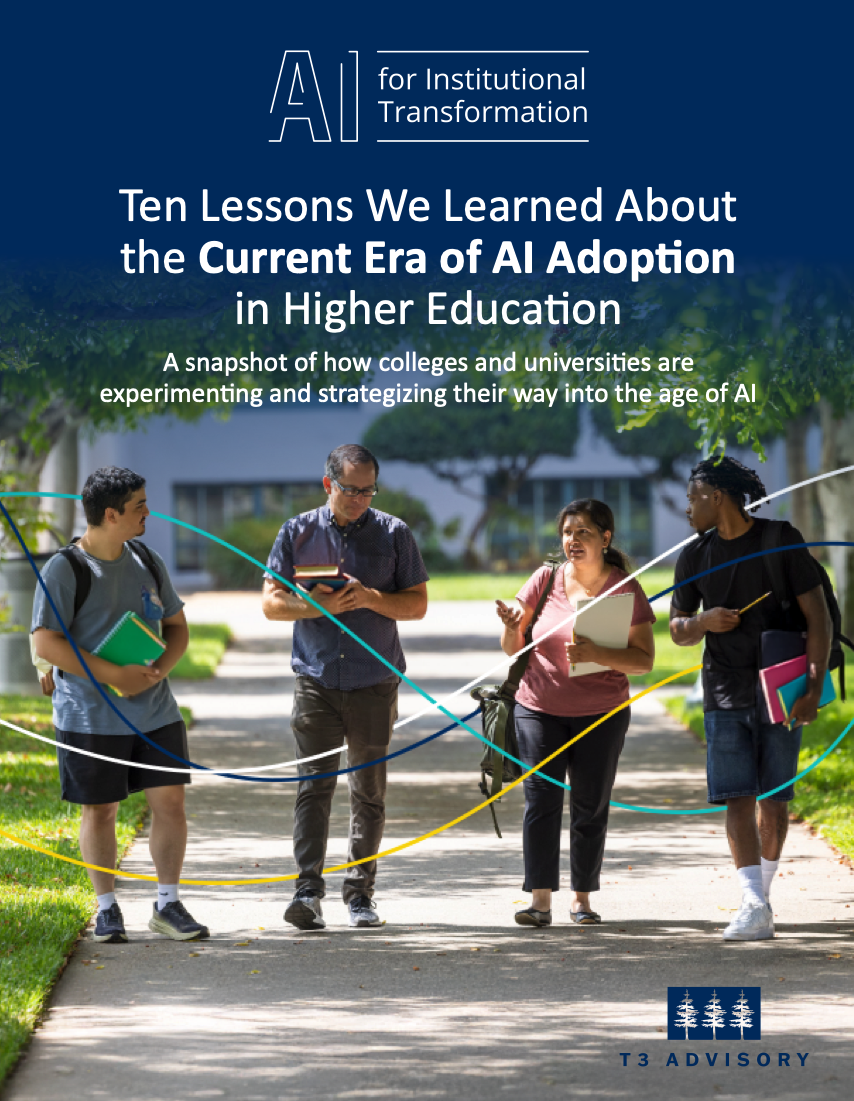
Cover art for T3 Advisory’s report on Generative AI Adoption in Higher Ed.
Since generative artificial intelligence (AI) burst into mainstream awareness in late 2022, it has quickly evolved from an emerging trend to a paradigm-shifting reality in higher education. As a sector, higher education institutions are striving to catch up to rapidly evolving systems. These individual efforts have resulted in rapid yet uneven shifts in response to the rise of artificial intelligence. Across the thousands of colleges and universities in the United States, there is an uneven capacity to respond to the changes brought about by AI (driven by gaps in financial resources, technical infrastructure, governance and policy, human capital, and change management and culture), which now defines the landscape of AI adoption. Colleges and universities across the United States are actively exploring how AI might enhance teaching, learning, student services, and operations. Yet despite this widespread interest, adoption at the institutional level remains uneven1. Most institutions remain in early or scaling stages, where AI use is driven by individual champions, pilot projects, or department-level experimentation. This landscape reflects both a growing awareness of AI’s potential and the persistent technical, financial, ethical, and cultural barriers that institutions must address. This report examines those barriers and highlights how institutional leaders are beginning to overcome them. Drawing on interviews with leaders from 33 institutions (both 2- and 4-year) nationwide, it provides a concise synthesis of adoption patterns, equity gaps, and emerging strategies for responsible AI integration. This summary report distills the insights of the full report— Adopting AI in Higher Education: Patterns, Challenges, and Emerging Practices— into key findings and implications designed for quicker reference and strategic use. A snapshot of how colleges and universities are experimenting and strategizing their way into the age of AI.