

What’s the Next Move in AI Adoption? What We Learned from Engaging at CCA’s NEXT Conference 2025
Katie O’Brien, Ph.D.
The T3 team had an amazing experience sharing our research and engaging with higher education leaders at Complete College America’s NEXT Conference in Baltimore last week! Across two pre-conference sessions, our research presentation, and lively tabling over the 3 days (including a Prompt Battle activity run by students from Coppin State University and an interactive wall), we had many engaging conversations and opportunities to extend our knowledge of how AI adoption is experienced by practitioners.
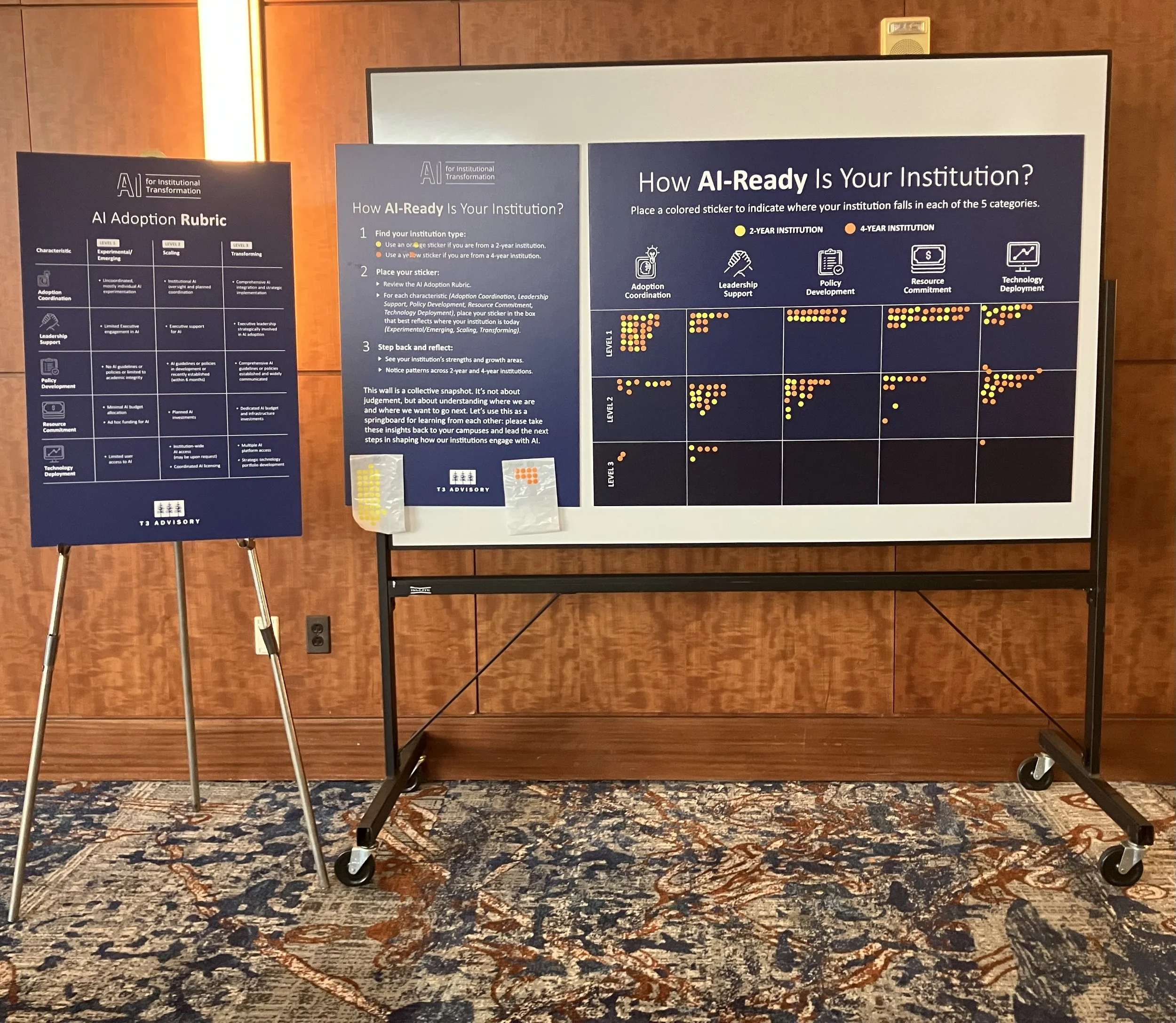
Our interactive rubric wall at the CCA NEXT Conference.
In the exhibitor space, we asked conference attendees to take part in our interactive wall using the rubric that we created for our national study. This rubric helps to categorize institutions into Experimental/Emerging, Scaling, and Transforming. The adoption categories use institutional behavioral indicators surrounding five areas:
Adoption Coordination
Leadership Support
Policy Development
Resource Commitment
Technology Deployment
We could see participants in real-time assessing their institutions’ AI adoption, and upon analyzing this data, the results were in line with what we found in our national study. Similar to the results we shared in our report, campuses were overwhelmingly in earlier to middling stages of AI adoption.
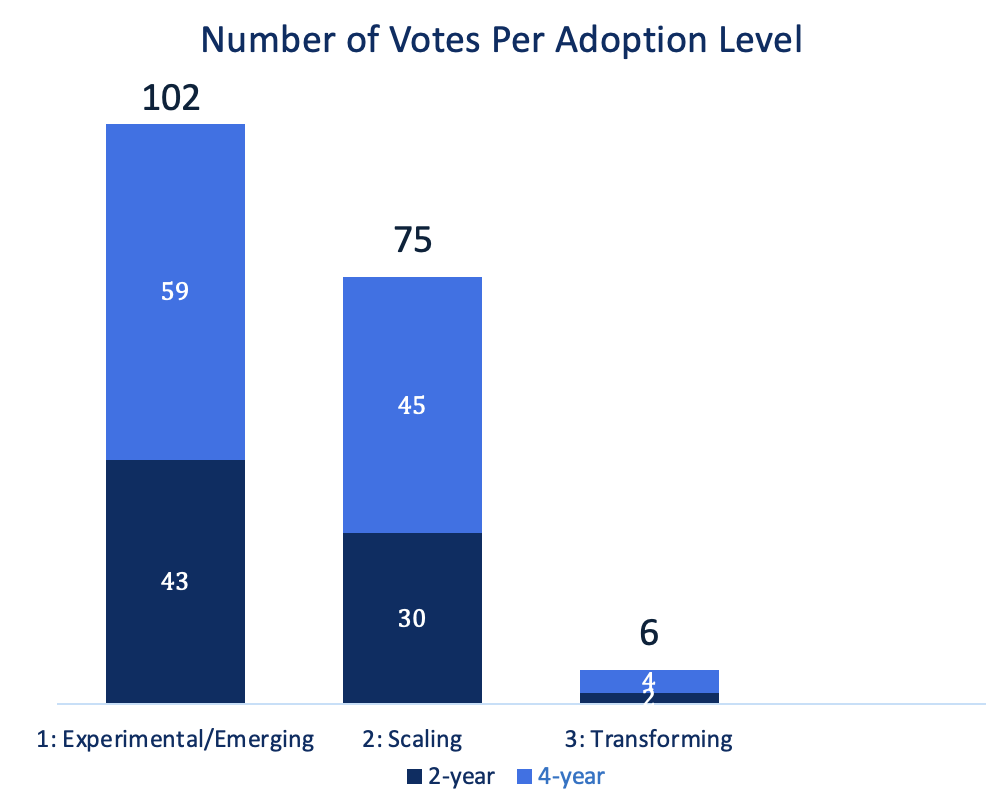
Data from our interactive rubric wall.
Additionally, 30 out of 41 votes assessed their institution as “Experimental/Emerging” in Adoption Coordination. This aligns with conversations in our sessions that even years into genAI’s introduction, adoption is still largely led by interested individuals, making for uncoordinated adoption and uneven implementation.
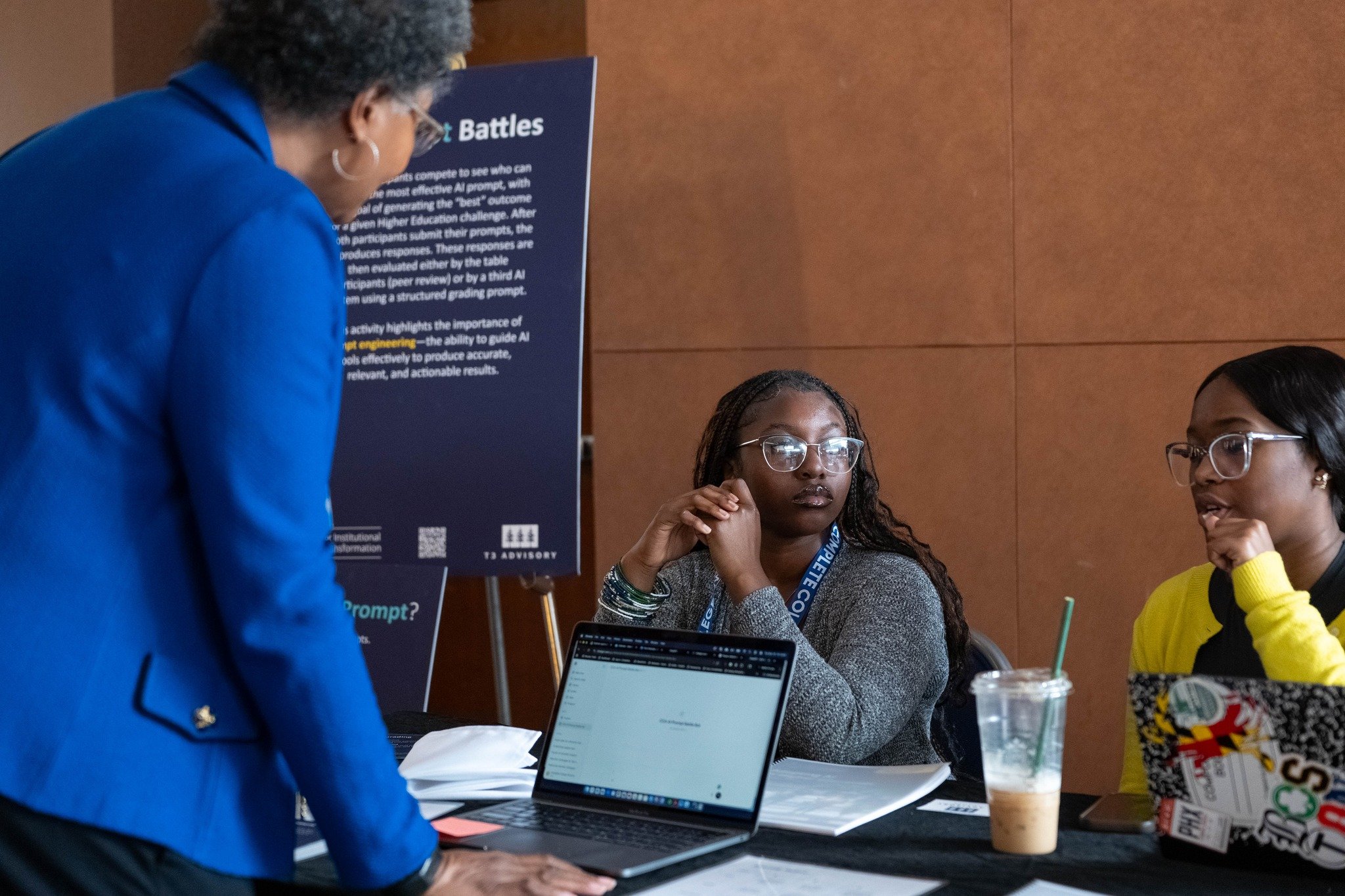
A conference attendee taking part in our student led AI-Prompt Battle activity (student volunteers from Coppin State University, a local HBCU).
So, what is the next move in AI adoption? How can we reach further scaling and transforming?
First, we need to recognize and honor that while there is widespread, increasing interest in AI, there is also fear holding us back from action. The narratives surrounding AI adoption have led practitioners to feel a sense of fear and shame in falling behind. Similar to sentiments expressed in our interviews, several declined participating in the rubric wall activity despite its anonymity, saying that their schools were still very early.
To counter this, more low-stakes learning opportunities are needed. At our AI prompt battle table, participants shared that it helped them to dispel their performance anxiety and fears of not doing AI “correctly.” Participants in our conference survey shared that beyond costs, “the challenges are knowledge gaps and resources,” which could be mitigated by dedicating such micro-dosed learning and real-time practice to build skills and confidence.
Finally, it is clear that a more central, strategic approach is needed. AI adoption in higher education is still early, and cannot reach further scaling if it is continued by the individual efforts that have gotten us to this point. By collaborating and making strategic efforts to build the infrastructure that research has identified, we can continue more effective adoption efforts toward institutional transformation. The positive, nuanced conversations that were had at the NEXT Conference are a step, and if we can continue this energy and connection, we can best navigate technological change for optimal educational outcomes.
Please join the conversations! All of our existing and upcoming research-driven resources can be found here.