

Students Are Already Making AI Decisions. Are You Listening?
Introducing the Student Voice Integration Framework, now available for free
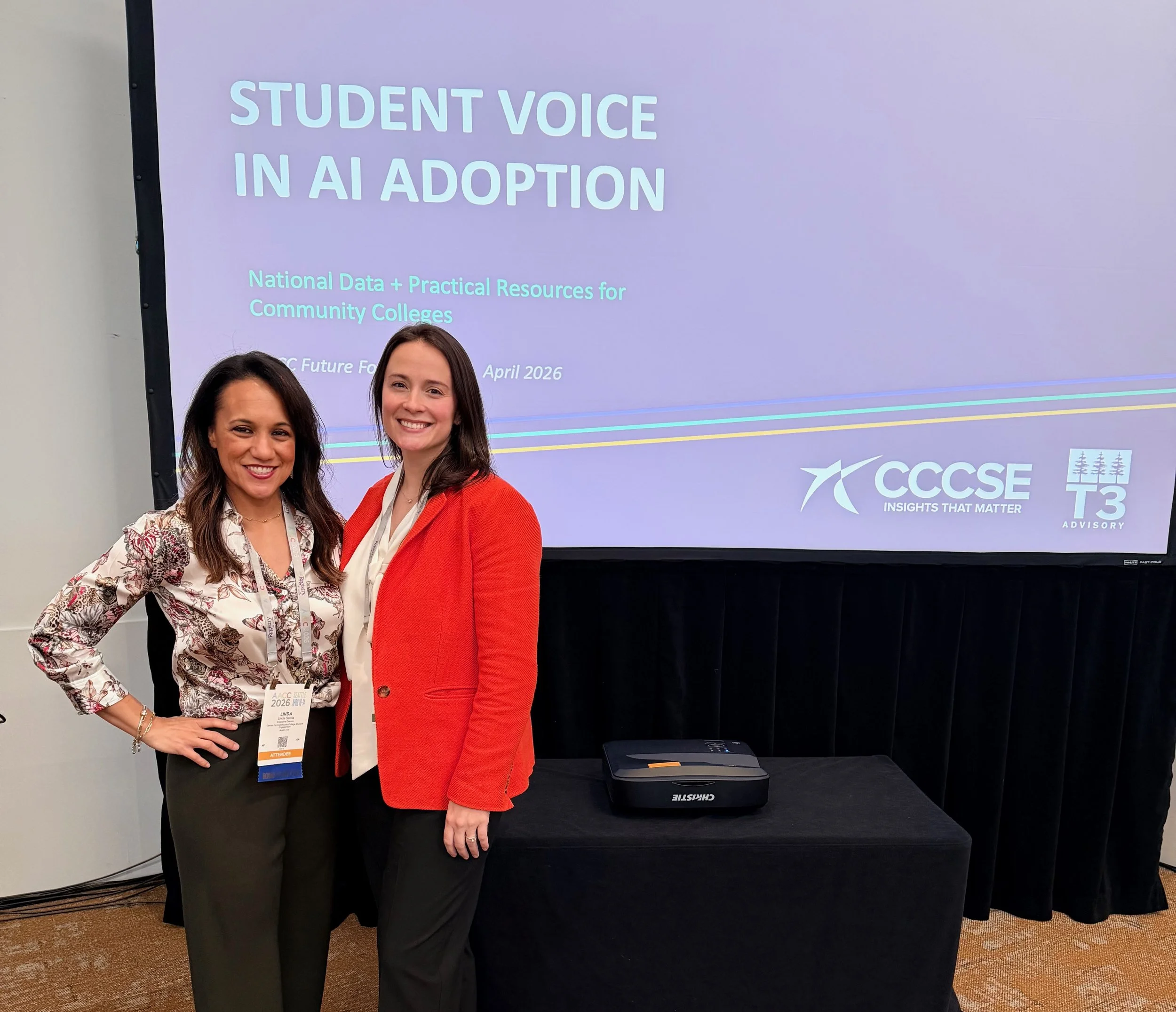
Dr. Linda Garcia and Dr. Audrey Ellis presenting at AACC in April 2026.
I really loved presenting with Dr. Linda García this week at AACC in Seattle. Linda is the Executive Director of the Center for Community College Student Engagement (CCCSE), and we teamed up at the AACC Future Focus Forum to talk about something I think deserves far more attention than it gets: the role of student voice in institutional AI adoption.
Linda brought national survey data from CCSSE and CCFSSE. I brought T3 Advisory's newest tool, the Student Voice Integration Framework, which we were sharing publicly for the first time. The pairing made for a session that was equal parts "here is what the data is telling us" and "here is what you can do about it."
The Numbers That Should Redirect the Conversation
The 2025 CCSSE and CCFSSE surveys captured more than 70,000 student responses and 3,000 faculty responses. A few findings anchor the case for why student voice belongs in AI adoption:
72% of students reported familiarity with AI tools, compared to 56% of faculty.
53% of students said they use AI for coursework, but 33% said none of their instructors had explained how AI tools should be used.
70% of faculty believe AI can improve student learning. Yet 54% of students disagreed that it has.
43% of part-time faculty said they did not know whether AI training is even provided at their college.
These numbers reveal a pattern of decisions being made without the perspective of the people most affected by them. Colleges are choosing tools, writing policies, and setting governance structures around AI right now. At most institutions, students are not part of those conversations.
What Students Know That Institutions Need
Student voice in AI adoption is not about inclusion as a principle. It is about the quality of the decisions being made. Students know which tools they are actually using. They know where guidance feels unclear or punitive. They can identify trust barriers before rollout, not after. They can tell you where AI might genuinely help their learning and where it creates confusion.
That is not an argument for courtesy. It is an argument for making better decisions with better information.
But building student voice infrastructure is not equally easy everywhere. The institutions that most need student perspective on AI, those with fewer resources, thinner governance structures, and heavier adjunct reliance, are often the ones with the least capacity to stand up advisory councils or run multi-phase engagement processes. The CCSSE data on part-time faculty (43% unaware of AI training at their own institution) is a window into that reality. This is why we designed the framework to offer multiple entry points, not a single model of what "good" looks like.
Introducing the Student Voice Integration Framework
T3 Advisory's Student Voice Integration Framework is a practical guide for embedding student perspectives into institutional AI decision-making. It maps recommended engagement mechanisms to six key decision areas: AI governance and strategy, policy development, tool selection and procurement, teaching and learning integration, student-facing AI services, and workforce partnerships.
For each area, the framework offers three tiers of engagement. Foundational approaches like surveys and town halls are not lesser versions of the work. They are the work, done at a scale many institutions can sustain. Developing practices like student seats on working groups build on that foundation when capacity allows. Advanced approaches like co-creating policies require deeper infrastructure and are the right fit for institutions ready for that level of partnership.
The point is not to climb a ladder. The point is to start, and to match the mechanism to what your institution can actually sustain and your students can actually shape.
Where to Start
Before you design engagement mechanisms, understand where your students actually are on AI. T3's AI Readiness Survey Pack includes a Student AI Use and Experience Survey built for exactly this purpose. Deploy it. Let the results tell you which mechanisms to prioritize and where input is most urgently needed.
And if you are a student reading this: these tools exist because your experience matters to the quality of your institution's AI decisions. If your college is not asking you yet, the framework includes language you can bring to a dean, a faculty member, or a student government body to start that conversation from your side.
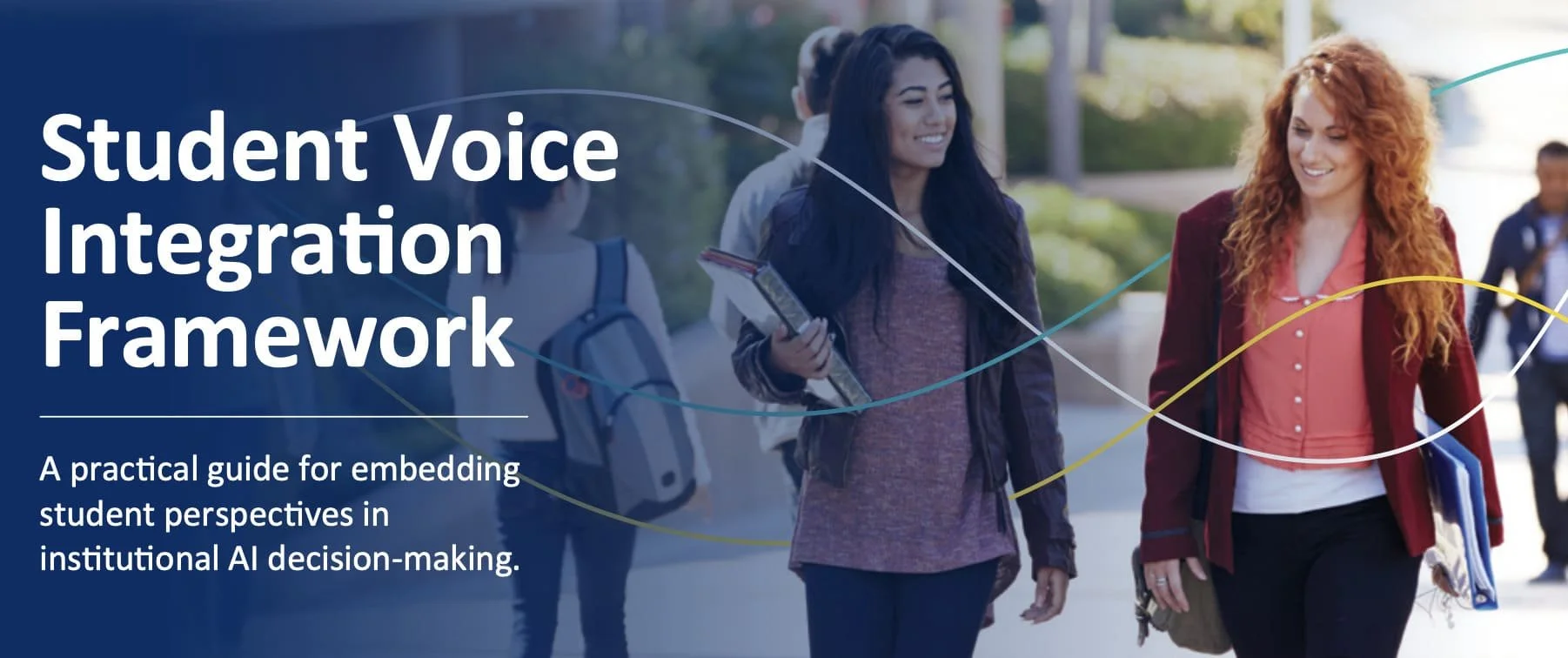
The framework, the survey pack, and the rest of T3's AI for Institutional Transformation toolkit are free and open access at www.t3advisory.com/ai-for-institutional-transformation.
This work is part of an ongoing research initiative led by T3 Advisory in partnership with Complete College America, funded by the Gates Foundation.